-- This feed and its contents are the property of The Huffington Post, and use is subject to our terms. It may be used for personal consumption, but may not be distributed on a website.
Tampilkan postingan dengan label full story. Tampilkan semua postingan
Tampilkan postingan dengan label full story. Tampilkan semua postingan
Senin, 20 April 2015
What It's Like To Live With Obsessive Compulsive Disorder
You probably aren't "a little obsessive-compulsive." I know because I am.

When A Queer Woman Counts Calories
I thought being in love with a woman meant I was immune to patriarchal beauty standards. Turns out, my girlfriend didn’t prevent me from having an eating disorder — but she did help nourish my recovery.
-- This feed and its contents are the property of The Huffington Post, and use is subject to our terms. It may be used for personal consumption, but may not be distributed on a website.
Charles Barkley Attempts To Do Yoga, Is Not Totally Terrible At It
What does one do in between the downtime of presenting NBA playoff games? For Charles Barkley, it’s (attempting) to get in some yoga.
The Round Mound of Rebound, who now serves as an NBA analyst for TNT, tried his very best to do a downward dog, and possibly some other positions? We’re not really sure.
Barkley has shared his thoughts on yoga before. Last fall, he told Jimmy Fallon that yoga is "just stretching in a hot room."
“You’re not trying to find your inner peace, or anything, you’re just trying to get your leg in a position that it normally doesn’t go in,” Barkley quipped, (also sharing that he even had plans to attend a SoulCycle session with his daughter).
All joking aside, Barkley did say in 2013 that Bikram yoga was “fantastic” for stretching as he’s gotten older.
The Round Mound of Rebound, who now serves as an NBA analyst for TNT, tried his very best to do a downward dog, and possibly some other positions? We’re not really sure.
...meanwhile, in the viewing room, Chuck shows off his yoga poses.
Posted by NBA on TNT on Sunday, 19 April 2015
Barkley has shared his thoughts on yoga before. Last fall, he told Jimmy Fallon that yoga is "just stretching in a hot room."
“You’re not trying to find your inner peace, or anything, you’re just trying to get your leg in a position that it normally doesn’t go in,” Barkley quipped, (also sharing that he even had plans to attend a SoulCycle session with his daughter).
All joking aside, Barkley did say in 2013 that Bikram yoga was “fantastic” for stretching as he’s gotten older.
-- This feed and its contents are the property of The Huffington Post, and use is subject to our terms. It may be used for personal consumption, but may not be distributed on a website.
Blake Griffin Eats Aron Baynes' Defense In 3 Tasty Dunks
So, how many licks does it take to get to the Tootsie Roll center of a Tootsie Pop?
Let's see.

One...

Two...

Three... (crunch).
Three.
The LA Clippers lead the San Antonio Spurs 1-0 after Sunday's 107-92 home win in the first round of the NBA playoffs. All-Star power forward Blake Griffin set the tone with a series of devastating dunks over Spurs center Aaron Baynes with just over six minutes left in the third quarter.
Let's see.
One...
Two...
Three... (crunch).
Three.
The LA Clippers lead the San Antonio Spurs 1-0 after Sunday's 107-92 home win in the first round of the NBA playoffs. All-Star power forward Blake Griffin set the tone with a series of devastating dunks over Spurs center Aaron Baynes with just over six minutes left in the third quarter.
-- This feed and its contents are the property of The Huffington Post, and use is subject to our terms. It may be used for personal consumption, but may not be distributed on a website.
Huge Explosion From Airstrikes Rock Yemeni Capital
TEHRAN, Iran (AP) — Iranian state TV says an airstrike by the Saudi-led coalition has hit close to the Iranian Embassy in the Yemeni capital, Sanaa, shattering windows but causing no casualties or injuries.
The report says Iran's Foreign Ministry summoned the kingdom's envoy to Tehran to protest over the bombing on Monday. It quotes Iran's deputy foreign minister, Hossein Amir Abdollahian, as warning the Saudis to abide by their international obligations and respect diplomatic missions. The report adds that Tehran holds Riyadh responsible for the safety of its mission in Sanaa.
Sanaa came under heavy bombardment on Monday as Saudi-led coalition warplanes targeted weapon caches held by Iranian-backed Shiite rebels known as the Houthis who have seized much of Yemen.
The Saudi air campaign in Yemen is now in its fourth week.
The report says Iran's Foreign Ministry summoned the kingdom's envoy to Tehran to protest over the bombing on Monday. It quotes Iran's deputy foreign minister, Hossein Amir Abdollahian, as warning the Saudis to abide by their international obligations and respect diplomatic missions. The report adds that Tehran holds Riyadh responsible for the safety of its mission in Sanaa.
Sanaa came under heavy bombardment on Monday as Saudi-led coalition warplanes targeted weapon caches held by Iranian-backed Shiite rebels known as the Houthis who have seized much of Yemen.
The Saudi air campaign in Yemen is now in its fourth week.
-- This feed and its contents are the property of The Huffington Post, and use is subject to our terms. It may be used for personal consumption, but may not be distributed on a website.
Scott Disick's View On Pubic Hair Is Totally Offensive
Sunday's "Keeping Up with the Kardashians" got dark. Scott Disick, Lord of Calabasas, is also apparently the lord of Kourtney Kardashian's pubic hair. One of the B-plots throughout the episode was Kourtney's nude pregnancy photo shoot with Brian Bowen Smith and Scott's desire for Kourtney to trim her pubic hair for the photos. "It's a little offensive," he told her when she confronted him about his request. Nah, Scott. You're a little offensive.
Sure, everyone has preferences, but Scott's disgust with Kourtney's "unkept lawn" makes it seem like it's inappropriate or unruly for a woman -- let alone a pregnant woman -- to have ungroomed pubic hair. (It's not, by the way.) On a call with Smith, Scott joked that he'll need a weed-whacker to cut through her pubic hair. "When her stomach is hanging over things, I don't think she gets how unkept her lawn can get," he said later in a confessional. "I think she forgets hair still grows downstairs."
As the episode continued, Kourtney told Scott she'd be open to shaving her pubic hair but needed his help. "It's lucky enough that I can shave my legs," she said. "There's a huge stomach here in the way so you're asking a lot to shave down there. I'm down. I just need some assistance."
His response: "Her bush is hanging out like it's the '80s and I'm not going to stand for that. If I have to get my hands dirty I will."
Last year, the Guardian declared 2014 "the year of the bush," but the reemergence of female pubic hair in pop culture has been undeniable for years now. Even the "Real Housewives of Beverly Hills" cast spent a good portion of last week's reunion talking about Lisa Rinna and Lisa Vanderpump's pubic hair. "I've got it down to my knees, for God's sake," Vanderpump had said earlier in the season.
So, shut it down, Scott. A woman's pubic hair is her own.
Watch the full clip from "Keeping Up with the Kardashians":
Sure, everyone has preferences, but Scott's disgust with Kourtney's "unkept lawn" makes it seem like it's inappropriate or unruly for a woman -- let alone a pregnant woman -- to have ungroomed pubic hair. (It's not, by the way.) On a call with Smith, Scott joked that he'll need a weed-whacker to cut through her pubic hair. "When her stomach is hanging over things, I don't think she gets how unkept her lawn can get," he said later in a confessional. "I think she forgets hair still grows downstairs."
As the episode continued, Kourtney told Scott she'd be open to shaving her pubic hair but needed his help. "It's lucky enough that I can shave my legs," she said. "There's a huge stomach here in the way so you're asking a lot to shave down there. I'm down. I just need some assistance."
His response: "Her bush is hanging out like it's the '80s and I'm not going to stand for that. If I have to get my hands dirty I will."
Last year, the Guardian declared 2014 "the year of the bush," but the reemergence of female pubic hair in pop culture has been undeniable for years now. Even the "Real Housewives of Beverly Hills" cast spent a good portion of last week's reunion talking about Lisa Rinna and Lisa Vanderpump's pubic hair. "I've got it down to my knees, for God's sake," Vanderpump had said earlier in the season.
So, shut it down, Scott. A woman's pubic hair is her own.
Watch the full clip from "Keeping Up with the Kardashians":
-- This feed and its contents are the property of The Huffington Post, and use is subject to our terms. It may be used for personal consumption, but may not be distributed on a website.
Denver Police Tweet Supportive Marijuana Message For 4/20 Rally
In what may go down as the coolest police tweet of all time, the Denver Police Department posted a message of tolerance for the "420" marijuana festivities taking place in the city over the weekend.
Late Sunday afternoon, on the second and last day of a massive annual 4/20 marijuana rally at Denver's Civic Center Park, Denver police tweeted this:
In a single lighthearted tweet, the Denver police illustrate just how far the drug war has been rolled back in Colorado -- which, in 2012, became the first state in the U.S. to legalize recreational marijuana -- with a play on lyrics from Chamillionaire's 2007 Grammy-winning song "Ridin'." By any objective standard, that is a pretty cool way for a police department to send a message to the public. When The Huffington Post sent a tweet to the police department account asking about the song referenced, the department noted that "#PoliceLikeToJamToo."
Although private recreational marijuana use has been legalized in the state, public consumption of the drug is still illegal. However, it does still occur, especially at large events. Denver police generally make enforcement of that law on 4/20 a low priority and target only the most egregious offenders.
Considering that an estimated 125,000 people attended the rally over the course of the weekend and that Denver police issued only approximately 160 total citations, it appears that police stuck to that strategy. The Associated Press reported Sunday that the police had seen no major issues throughout the weekend.
The police tweeted friendly reminders all weekend about the state's marijuana law, asking people to "consume responsibly" and "make safety a priority" and noting that officers would "prefer not to be buzzkills" at the marijuana gathering.
Although the real "Weed Day" is Monday, a new city ordinance that puts a moratorium on three-day events limited rally organizers to celebrate all things cannabis for just the weekend.
Late Sunday afternoon, on the second and last day of a massive annual 4/20 marijuana rally at Denver's Civic Center Park, Denver police tweeted this:
We see you rollin, but we ain't hatin’ HAHA… Seriously though, #Denver, please remember to #ConsumeResponsibly this 4/20 weekend.
— Denver Police Dept. (@DenverPolice) April 20, 2015
In a single lighthearted tweet, the Denver police illustrate just how far the drug war has been rolled back in Colorado -- which, in 2012, became the first state in the U.S. to legalize recreational marijuana -- with a play on lyrics from Chamillionaire's 2007 Grammy-winning song "Ridin'." By any objective standard, that is a pretty cool way for a police department to send a message to the public. When The Huffington Post sent a tweet to the police department account asking about the song referenced, the department noted that "#PoliceLikeToJamToo."
Although private recreational marijuana use has been legalized in the state, public consumption of the drug is still illegal. However, it does still occur, especially at large events. Denver police generally make enforcement of that law on 4/20 a low priority and target only the most egregious offenders.
Considering that an estimated 125,000 people attended the rally over the course of the weekend and that Denver police issued only approximately 160 total citations, it appears that police stuck to that strategy. The Associated Press reported Sunday that the police had seen no major issues throughout the weekend.
The police tweeted friendly reminders all weekend about the state's marijuana law, asking people to "consume responsibly" and "make safety a priority" and noting that officers would "prefer not to be buzzkills" at the marijuana gathering.
Although the real "Weed Day" is Monday, a new city ordinance that puts a moratorium on three-day events limited rally organizers to celebrate all things cannabis for just the weekend.
-- This feed and its contents are the property of The Huffington Post, and use is subject to our terms. It may be used for personal consumption, but may not be distributed on a website.
Joe Manchin: Harry Reid's Leadership In The Senate Did Not Work
Sen. Joe Manchin (D-W.Va.) called out Senate Minority Leader Harry Reid (D-Nev.) on Monday, saying his leadership didn't work.
"Well first of all, Harry's a good man," Manchin said while appearing on MSNBC’s "Morning Joe." "His leadership and the things he thought would work did not. So with that, you just move on."
In March, Reid announced he would be retiring in 2016. Reid has led the Senate Democrats since 2005 and has served in the U.S. Senate since 1987.
Manchin recently announced he would seek another term in the Senate and will not run for governor of West Virginia.
"Me walking away, I think, would be much worse when I have a chance to make a difference," Manchin said.
The top issue Manchin said he wants to address in the Senate going forward is drug abuse.
"It's just devastating in my state. It's killing families. ... This drug culture we have is killing America," Manchin said.
Watch the video above.
"Well first of all, Harry's a good man," Manchin said while appearing on MSNBC’s "Morning Joe." "His leadership and the things he thought would work did not. So with that, you just move on."
In March, Reid announced he would be retiring in 2016. Reid has led the Senate Democrats since 2005 and has served in the U.S. Senate since 1987.
Manchin recently announced he would seek another term in the Senate and will not run for governor of West Virginia.
"Me walking away, I think, would be much worse when I have a chance to make a difference," Manchin said.
The top issue Manchin said he wants to address in the Senate going forward is drug abuse.
"It's just devastating in my state. It's killing families. ... This drug culture we have is killing America," Manchin said.
Watch the video above.
-- This feed and its contents are the property of The Huffington Post, and use is subject to our terms. It may be used for personal consumption, but may not be distributed on a website.
Perfectly Good Produce Discarded At U.S. Border Feeds People In Need
A nonprofit is giving a second life to produce discarded at the U.S. border by distributing it to people in need.
Borderlands Food Bank, in Nogales, Arizona, sits right on the border of the United States and Mexico -- the crossing where over half the produce imported from Mexico comes through, NPR reports. All products must pass a strict inspection prior to distribution, and often cannot be sold if they have even the slightest imperfection.
But before these fruits and vegetables are sent to landfill, Borderlands intercepts the products to try and give them a second chance to feed people in need. Currently, the organization rescues 35 to 40 million pounds of edible produce each year.
“Some produce arrives spotted, or there’s scarring or black dots on the product, but it’s perfectly good,” Borderlands President Yolanda Soto told The Huffington Post. “By rescuing this poundage [of produce] we are able to move it to families who aren’t able to eat nutritiously.”

Distributing this rejected -- but perfectly safe -- produce is a massive undertaking. Borderlands works with 200 donors to distribute food to 389 registered nonprofits, in both Mexico and the United States. About 47 percent of those agencies are in the state of Arizona alone.
“We sit right in the middle of a produce industry,” Soto told HuffPost. “Once we saturate Arizona, we then offer produce to 18 other states throughout the nation.”
Soto receives calls all day long from her long list of donors; they know which of their discarded produce she will take. She then sends one of her trucks to retrieve the product to bring back Borderlands’ 13,000 square foot warehouse.
Monday at the warehouse are agency days -- nonprofits come directly to the food bank to take large quantities of fruits and vegetables to bring to their organizations. Tuesday through Friday, Borderland hosts a direct client distribution program. And weekends are devoted to POWWOW: Produce On Wheels - With Out Waste, which distributes produce to communities throughout the state of Arizona.
Borderlands’ impact is widespread and far-reaching, but their warehouse is small. Rent isn’t cheap, and Soto is hoping to find a partner to help Borderlands expand to a space where it can grow.
“If we found a bigger warehouse, we could rescue a lot more,” Sota said. “So much can be salvaged, and there is so much need.”
H/T NPR
 Like Us On Facebook
 Follow Us On Twitter
Borderlands Food Bank, in Nogales, Arizona, sits right on the border of the United States and Mexico -- the crossing where over half the produce imported from Mexico comes through, NPR reports. All products must pass a strict inspection prior to distribution, and often cannot be sold if they have even the slightest imperfection.
But before these fruits and vegetables are sent to landfill, Borderlands intercepts the products to try and give them a second chance to feed people in need. Currently, the organization rescues 35 to 40 million pounds of edible produce each year.
“Some produce arrives spotted, or there’s scarring or black dots on the product, but it’s perfectly good,” Borderlands President Yolanda Soto told The Huffington Post. “By rescuing this poundage [of produce] we are able to move it to families who aren’t able to eat nutritiously.”
Distributing this rejected -- but perfectly safe -- produce is a massive undertaking. Borderlands works with 200 donors to distribute food to 389 registered nonprofits, in both Mexico and the United States. About 47 percent of those agencies are in the state of Arizona alone.
“We sit right in the middle of a produce industry,” Soto told HuffPost. “Once we saturate Arizona, we then offer produce to 18 other states throughout the nation.”
Soto receives calls all day long from her long list of donors; they know which of their discarded produce she will take. She then sends one of her trucks to retrieve the product to bring back Borderlands’ 13,000 square foot warehouse.
Monday at the warehouse are agency days -- nonprofits come directly to the food bank to take large quantities of fruits and vegetables to bring to their organizations. Tuesday through Friday, Borderland hosts a direct client distribution program. And weekends are devoted to POWWOW: Produce On Wheels - With Out Waste, which distributes produce to communities throughout the state of Arizona.
Borderlands’ impact is widespread and far-reaching, but their warehouse is small. Rent isn’t cheap, and Soto is hoping to find a partner to help Borderlands expand to a space where it can grow.
“If we found a bigger warehouse, we could rescue a lot more,” Sota said. “So much can be salvaged, and there is so much need.”
H/T NPR
Like Us On Facebook Follow Us On Twitter-- This feed and its contents are the property of The Huffington Post, and use is subject to our terms. It may be used for personal consumption, but may not be distributed on a website.
The Steve Ballmer Dance Is Back With A Vengeance
The Los Angeles Clippers are back in the playoffs. That’s all well and good, but what we’re really excited about is the playoff debut of Clippers owner Steve Ballmer, who is about as excited as you’d expect.
It’s not as good as some of his other dances this season, but it’s a good start to what we hope will be a long playoff run for Ballmer. Also down with the kid behind him who seems to be having an equally good time.

It’s not as good as some of his other dances this season, but it’s a good start to what we hope will be a long playoff run for Ballmer. Also down with the kid behind him who seems to be having an equally good time.
-- This feed and its contents are the property of The Huffington Post, and use is subject to our terms. It may be used for personal consumption, but may not be distributed on a website.
3 Superfoods That Make Smoothies Taste Less 'Green' (VIDEO)
Packed with vitamins and nutrients, green smoothies are known for their great health benefits; but when it comes to flavor, raw kale and spinach don't have the best reputation. To compensate for the grass-like taste, many smoothie recipes call for heaps of sugary-sweet fruits.
As a better alternative, Melisse Gelula and Alexia Brue, founders of the health and fitness website Well + Good, have come up with three superfood ingredients to enhance the flavor of any basic smoothie recipe without increasing the sugar content.
Well + Good Basic Green Smoothie Recipe
1 cup of milk (soy, almond or coconut)
1/2 frozen banana
1 cup of greens (spinach, kale or swiss chard)
1 spoonful of any of the below superfood ingredients
Matcha Tea
"This is a ground green tea from Japan," Gelula says. "What's really wonderful about it is it has less caffeine (but you will get a little zing), [is] really high in antioxidants, really high in fiber, [and has] zero calories."
Raw Cacao Powder
"It's filled with antioxidants, it has no sugar in it at all," Brue says. "It also has a surprising amount of iron and fiber."
Gelula adds that cacao is also an excellent palate pleaser. "It makes the smoothie incredibly delicious," she says.
Cinnamon
"We really love cinnamon," Gelula says. "It's been known to help regulate blood sugar, which is really great if you've got a lot of fruit in your smoothies anyway, so you're sort of balancing out the sugar content and the effect that it will have on you."
Still too "green" for your liking? To add even more flavor to your smoothie, Gelula and Brue say a tablespoon of nut butter or coconut oil will really improve the taste. A handful of fruit will also do the trick -- but go easy to avoid adding too much sugar.
More from #OWNSHOW: Why health fanatics can't stop talking about "bone broth."
Like Us On Facebook |
Follow Us On Twitter
As a better alternative, Melisse Gelula and Alexia Brue, founders of the health and fitness website Well + Good, have come up with three superfood ingredients to enhance the flavor of any basic smoothie recipe without increasing the sugar content.
Well + Good Basic Green Smoothie Recipe
1 cup of milk (soy, almond or coconut)
1/2 frozen banana
1 cup of greens (spinach, kale or swiss chard)
1 spoonful of any of the below superfood ingredients
Matcha Tea
"This is a ground green tea from Japan," Gelula says. "What's really wonderful about it is it has less caffeine (but you will get a little zing), [is] really high in antioxidants, really high in fiber, [and has] zero calories."
Raw Cacao Powder
"It's filled with antioxidants, it has no sugar in it at all," Brue says. "It also has a surprising amount of iron and fiber."
Gelula adds that cacao is also an excellent palate pleaser. "It makes the smoothie incredibly delicious," she says.
Cinnamon
"We really love cinnamon," Gelula says. "It's been known to help regulate blood sugar, which is really great if you've got a lot of fruit in your smoothies anyway, so you're sort of balancing out the sugar content and the effect that it will have on you."
Still too "green" for your liking? To add even more flavor to your smoothie, Gelula and Brue say a tablespoon of nut butter or coconut oil will really improve the taste. A handful of fruit will also do the trick -- but go easy to avoid adding too much sugar.
More from #OWNSHOW: Why health fanatics can't stop talking about "bone broth."
Like Us On Facebook | Follow Us On Twitter-- This feed and its contents are the property of The Huffington Post, and use is subject to our terms. It may be used for personal consumption, but may not be distributed on a website.
Rapid Rise In Super PACs Dominated By Single Donors
This story was co-published with the Daily Beast.
The wealthiest Americans can fly on their own jets, live in gated compounds and watch movies in their own theaters.
More of them also are walling off their political contributions from other big and small players.
A growing number of political committees known as super PACs have become instruments of single donors, according to a ProPublica analysis of federal records. During the 2014 election cycle, $113 million 2013 16 percent of money raised by all super PACs 2013 went to committees dominated by one donor. That was quadruple their 2012 share.
The rise of single-donor groups is a new example of how changes in campaign finance law are giving outsized influence to a handful of funders.
The trend may continue into 2016. Last week, National Review reported that Texas Senator Ted Cruz's bid for the Republican presidential nomination would be boosted not by one anointed super PAC but four, each controlled by a single donor or donor family.
The Supreme Court's 2010 Citizens United ruling helped usher in the era of super PACs. Unlike traditional political action committees, the independent groups can accept donations of any dollar size as long as they don't coordinate with the campaign of any candidate. Previously, much of the focus in big-money fundraising was on "bundlers" -- volunteers who tap friends and associates for maximum individual contributions of $5,400 to a candidate, then deliver big lump sums directly to the campaigns. Former president George W. Bush awarded his most prolific bundlers special titles such as "Ranger" and "Pioneer."
While bundling intensified the impact of wealthy donors on campaigns, the dollar limits and the need to join with others diluted the influence of any one person. With a super PAC, a donor can single-handedly push a narrower agenda. Last year, National Journal profiled one such donor 2013 a California vineyard owner who helped start the trend by launching his own super PAC and becoming a power player in a Senate race across the country.
Beyond the single-donor groups, big donations are dominant across all kinds of super PACs, according to the analysis. Six-figure contributions from individuals or organizations accounted for almost 50 percent of all super PAC money raised during the last two cycles.
"We are anointing an aristocracy that's getting a stronger and stronger grip on democracy," said Miles Rapoport, president of Common Cause, an advocacy group that seeks to reduce the influence of money on politics.
ProPublica's analysis identified 59 super PACs that received at least 80 percent of their funding from one individual during the 2014 cycle. They raised a total of $113 million, compared with the $33 million raised by the 34 such groups that existed in 2012.
Donors who launch their own PACs are seeking more control over how their money is spent. And many have complained about the commissions that fundraising consultants take off the top of their donations to outside groups. But the move carries risks if the patron is new to the arena.
To see a list of the top single-donor PACs from 2012 and 2014, visit ProPublica.
In one cautionary tale, a reclusive 89-year-old Texas oilman with no political experience launched Vote2ReduceDebt, one of the nation's highest-spending conservative super PACs. A ProPublica investigation found that much of the donor's millions went to entities run by the group's consultants or their close associates. The super PAC imploded as principals traded allegations including self-dealing, faked campaign events and a plot to siphon the PAC's money to a reality TV show.
Bill Burton, a former Obama administration official who helped found Priorities USA, the juggernaut super PAC affiliated with the president's reelection campaign, said he expects donors to face more problems if they continue to go it alone.
"One of two things is going to happen," he said. "We will either see widespread flaunting of coordination rules or we will see some pretty spectacular failures to the tune of millions of dollars."
The single-donor super PACs identified by ProPublica span the political spectrum. Among the top conservative donors were Richard Uihlein, a packaging supplies businessman, and casino magnate Sheldon Adelson. Former New York City mayor Michael Bloomberg spent heavily on both sides but leaned Democrat. Hedge fund titan Tom Steyer dominated on the left.
In 2012 the largest single-donor super PAC was former TD Ameritrade CEO Joe Ricketts' Ending Spending Action Fund, which raised over $14 million, 89 percent of which came from Ricketts. It was the ninth-largest super PAC by spending. In 2014 Steyer's Nextgen Climate Action was the largest super PAC, raising almost $78 million, 85 percent from Steyer. (Steyer's wife, Kat Taylor, is a member of ProPublica's board of directors, and the couple has donated to ProPublica.)
In addition to the super PACs dominated by a single individual, dozens more received the great majority of their funding from one corporation, labor group or advocacy organization. In 2014, those PACs represented 8.6 percent of super-PAC fundraising.
PACs dominated by one donor could run afoul of disclosure laws, according to Larry Noble, the former top lawyer for the Federal Election Commission. Under the rules, political ads must include disclosures about who funded them. Noble said election law would require groups funded by one person to list that donor's name, not just the name of the PAC 2013 though he couldn't recall the FEC addressing such a case.
Naming the super PAC instead of the donor in the ad, Noble said, also allows the groups to delay disclosing where their money comes from until the next FEC filing date 2013 potentially weeks after the ad runs.
"It defeats the purpose of the law to allow someone to hide behind a super PAC if they are the only funder," Noble said.
"They want to make it more authoritative, like there's more support. It looks better to say the ad is from Americans for Good Government than from John Smith2026 That just makes a mockery of the law."
Help us investigate: Have a tip about campaign finance? Email robert.faturechi@propublica.org.
Related stories: For more coverage of campaign finance, read ProPublica's previous reporting on Super PAC Men, secret donors and gaps in campaign finance rules.
ProPublica is a Pulitzer Prize-winning investigative newsroom. Sign up for their newsletter.
-- This feed and its contents are the property of The Huffington Post, and use is subject to our terms. It may be used for personal consumption, but may not be distributed on a website.
12 Mother's Day Cards For Cool Moms, Not Regular Moms
Mother's Day is coming. Back away from the corny Hallmark cards.
For everyone celebrating the mothers (and/or mother figures) in their life this year, we've got your back. Here's a selection of funny, cute and cheeky cards for any mom with a sense of humor. Because who wants rhyming prose when you could have pug puns?
Here are 12 funny Mother's Day cards we love:
1. An apology for the rough times:
"This Mother's Day, I Would Like To Apologize For.."

2. An appreciation of the important skills she taught you:
"Thanks for teaching me how to use a big-girl potty."

3. A serious understatement:
"I suppose you're a reasonable mother"

4. An acknowledgement of what she just can't say:
"I love how we don't have to say out loud that I'm your favorite child."

5. A much-needed thank-you:
"Thanks for not psychologically damaging me."

6. An admission she's been waiting to hear:
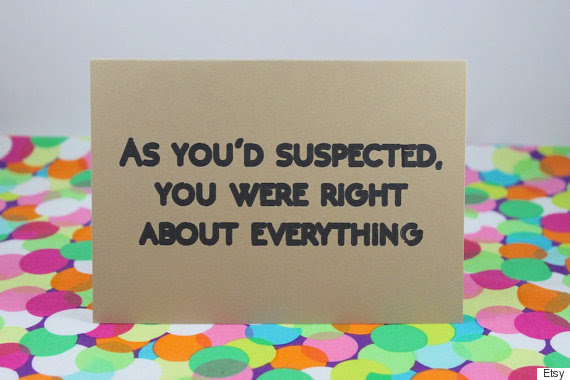
"You were right about everything."
7. A tribute to "Mean Girls:"
"You're a cool mom."

8. A nod to all the roles she plays:
"My cheapest therapist."

9. A punny endearment:
"Nothing beets you."

10. A "Gilmore Girls" reference:
"You're the Lorelai to my Rory."

11. A "Puggin'" cute card:
"I puggin' love you."

12. A congratulatory note:
"Great job Mom, I turned out awesome"

For everyone celebrating the mothers (and/or mother figures) in their life this year, we've got your back. Here's a selection of funny, cute and cheeky cards for any mom with a sense of humor. Because who wants rhyming prose when you could have pug puns?
Here are 12 funny Mother's Day cards we love:
1. An apology for the rough times:
"This Mother's Day, I Would Like To Apologize For.."
2. An appreciation of the important skills she taught you:
"Thanks for teaching me how to use a big-girl potty."
3. A serious understatement:
"I suppose you're a reasonable mother"
4. An acknowledgement of what she just can't say:
"I love how we don't have to say out loud that I'm your favorite child."
5. A much-needed thank-you:
"Thanks for not psychologically damaging me."
6. An admission she's been waiting to hear:
"You were right about everything."
7. A tribute to "Mean Girls:"
"You're a cool mom."
8. A nod to all the roles she plays:
"My cheapest therapist."
9. A punny endearment:
"Nothing beets you."
10. A "Gilmore Girls" reference:
"You're the Lorelai to my Rory."
11. A "Puggin'" cute card:
"I puggin' love you."
12. A congratulatory note:
"Great job Mom, I turned out awesome"
-- This feed and its contents are the property of The Huffington Post, and use is subject to our terms. It may be used for personal consumption, but may not be distributed on a website.
Faithful Runners: Why Churches Are Running Marathons For God
At the start of the Boston Marathon next Monday, runners will congregate by a church that posts a banner with an appropriate Bible verse: “Those who hope in the Lord will renew their strength. They will run and not grow weary; they will walk and not be faint.”
Many people of faith are taking this promise from Isaiah literally. Long a place where the faithful went to sit, churches are becoming a place where people go to run.
In Georgia, a layman started a program called “God on the Run” out of his garage; he's now sold 60,000 books in 49 states. Programs such as “Pew to 5K” mimic a secular training program called “Couch to 5K” and some churches are putting on their own races, either as fundraisers or to nudge their members into health.
Many people of faith are taking this promise from Isaiah literally. Long a place where the faithful went to sit, churches are becoming a place where people go to run.
In Georgia, a layman started a program called “God on the Run” out of his garage; he's now sold 60,000 books in 49 states. Programs such as “Pew to 5K” mimic a secular training program called “Couch to 5K” and some churches are putting on their own races, either as fundraisers or to nudge their members into health.
-- This feed and its contents are the property of The Huffington Post, and use is subject to our terms. It may be used for personal consumption, but may not be distributed on a website.
Cubs Pitcher Jon Lester Got The Ball Stuck In His Glove, So He Tossed The Glove To First
In baseball there are plays and then there are plays.
Qualifying for the latter is this move by Cubs pitcher Jon Lester on Sunday, who, after the ball got stuck in his glove, got creative and tossed the whole thing to his first baseman to get the out during the second inning.
Equal points to Anthony Rizzo for quickly ditching his own glove so he could cradle Lester’s glove and ball with the tenderness and care it deserved.
Unfortunately, it wasn’t enough for the Cubs, who fell to the Padres, 2-5.
Qualifying for the latter is this move by Cubs pitcher Jon Lester on Sunday, who, after the ball got stuck in his glove, got creative and tossed the whole thing to his first baseman to get the out during the second inning.
Equal points to Anthony Rizzo for quickly ditching his own glove so he could cradle Lester’s glove and ball with the tenderness and care it deserved.
Unfortunately, it wasn’t enough for the Cubs, who fell to the Padres, 2-5.
-- This feed and its contents are the property of The Huffington Post, and use is subject to our terms. It may be used for personal consumption, but may not be distributed on a website.
Here's Everything You Need To Know About Why We Celebrate Weed On 4/20
Warren Haynes, the Allman Brothers Band guitarist, routinely plays with the surviving members of the Grateful Dead, touring as The Dead. It's the spring of 2009, he's just finished a Dead show in Washington, D.C., and he gets a pop quiz from The Huffington Post.
Where does "420" come from?
He pauses and thinks, hands on his sides. "I don't know the real origin. I know myths and rumors," he says. "I'm really confused about the first time I heard it. It was like a police code for smoking in progress or something. What's the real story?"
Wavy Gravy is a hippie icon with his own ice cream flavor who has been hanging out with the Dead for decades. HuffPost spots him outside the same concert. Asked about the term 420, he suggests it began "somewhere in the foggy mists of time. What time is it now? I say to you, 'Eternity now.'"
Depending on whom you ask or their state of inebriation, there are as many varieties of answers as strains of medical bud in California. It's the number of active chemicals in marijuana. It's teatime in Holland. It has something to do with Hitler's birthday. It's those numbers in that Bob Dylan song multiplied.
The origin of the term 420, celebrated around the world by pot smokers every April 20, has long been obscured by the clouded memories of the folks who made it a phenomenon.
The Huffington Post chased the term back to its roots and was able to find them in a lost patch of cannabis in a Point Reyes, Calif., forest. Just as interesting as its origin, it turns out, is how it spread.
It starts with the Dead.
It was Christmas week 1990 in Oakland. Steven Bloom was wandering through The Lot, that timeless gathering of hippies that springs up in the parking lot before every Grateful Dead concert, when a Deadhead handed him a yellow flyer.
"We are going to meet at 4:20 on 4/20 for 420-ing in Marin County at the Bolinas Ridge sunset spot on Mt. Tamalpais," read the message, which Bloom dug up and forwarded to HuffPost. Bloom, then a reporter for High Times magazine and now the publisher of CelebStoner.com and co-author of "Pot Culture," had never heard of "420-ing" before.
The flyer came complete with a 420 backstory: "420 started somewhere in San Rafael, California in the late '70s. It started as the police code for Marijuana Smoking in Progress. After local heads heard of the police call, they started using the expression 420 when referring to herb -- Let's Go 420, dude!"
Bloom reported his find in the May 1991 issue of High Times, which the magazine found in its archives and provided to HuffPost. The story, though, was only partially right.
The origin of 420 had nothing to do with a police code, though the San Rafael part was dead-on. A group of five San Rafael High School friends known as the Waldos -- by virtue of their chosen hangout spot, a wall outside the school -- coined the term in 1971.
The Waldos never envisioned that pot smokers the world over would celebrate each April 20 as a result of their foray into the Point Reyes forest. The day has managed to become something of a national holiday in the face of official condemnation. Officials at the University of Colorado at Boulder and the University of California, Santa Cruz, which boast two of the biggest "smokeouts," pushed back in 2009 in typical fashion. "As another April 20 approaches, we are faced with concerns from students, parents, alumni, Regents, and community members about a repeat of last year's 4/20 'event,'" wrote Boulder's chancellor in a letter to students. "On April 20, 2009, we hope that you will choose not to participate in unlawful activity that debases the reputation of your University and degree, and will encourage your fellow Buffs to act with pride and remember who they really are."
But the Cheshire cat is out of the bag. Students and locals will show up around four, light up at 4:20 and be gone shortly thereafter. No bands, no speakers, no chants. Just a bunch of people getting together and getting stoned.
THE FIVE WALDOS
Today the code often creeps into popular culture and mainstream settings. Some of the clocks in "Pulp Fiction," for instance, are set to 4:20. A "Price Is Right" contestant won YouTube celebrity by bidding either $420 or $1,420 for everything. In 2003, when the California Legislature codified the medical marijuana law that voters had approved, the bill was named SB 420.
"We think it was a staffer working for [lead Assembly sponsor Mark] Leno, but no one has ever fessed up," says Steph Sherer, head of Americans for Safe Access, which lobbied on behalf of the bill.
California legislative staffers spoken to for this story say that the 420 designation remains a mystery, but that both Leno and the lead Senate sponsor, John Vasconcellos, are hip enough that they must have known what it meant. Vasconcellos says he has no idea how it got the number 420 and wouldn't have known what it meant at the time. (If you were involved with SB 420 and know the story, email me.)
The code also pops up in Craigslist postings when fellow smokers search for "420 friendly" roommates. "It's just a vaguer way of saying it, and it kind of makes it kind of cool," says Bloom, the pot journalist. "Like, you know you're in the know, but that does show you how it's in the mainstream."
The Waldos have proof, however, that they used the term in the early '70s. When HuffPost spoke with the men in 2009, they requested anonymity, preferring to go by the names they call each other -- Waldo Steve, Waldo Dave, Waldo Mark, etc. Pot was still, after all, illegal.
Since then, however, California has decriminalized possession of marijuana so that getting snagged costs little more than a parking ticket. Medical marijuana shops dot the landscape, and the plant has become dramatically more culturally acceptable.
In the spring of 2012, they agreed to go on the record with HuffPost.
"The baby boomers have been taking over. People are dying off. The generations behind them are fine," explains Steve Capper.
"I think I read recently a poll where somewhere like 47 percent of the American public are okay with marijuana," says Dave Reddix. (In March 2012, a Rasmussen poll found 47 percent of Americans support legalization of marijuana.)
Mark Gravitch also agreed to be identified. The other two aren't yet ready.
The Waldos' story goes like this: One day in the fall of 1971 -- harvest time -- the Waldos got word of a Coast Guard service member who could no longer tend his plot of marijuana plants near the Point Reyes Peninsula Coast Guard station. A treasure map in hand, the Waldos decided to pluck some of the free bud.
The Waldos, who were all athletes, agreed to meet at the statue of Louis Pasteur outside the school at 4:20 p.m., after practice, to begin the hunt.
"We would remind each other in the hallways we were supposed to meet up at 4:20. It originally started out 4:20-Louis, and we eventually dropped the Louis," Capper, 57, says.
The first forays were unsuccessful, but the group kept looking for the hidden crop. "We'd meet at 4:20 and get in my old '66 Chevy Impala, and, of course, we'd smoke instantly and smoke all the way out to Point Reyes and smoke the entire time we were out there. We did it week after week," says Capper. "We never actually found the patch."
But they did find a useful codeword. "I could say to one of my friends, I'd go, '420,' and it was telepathic. He would know if I was saying, 'Hey, do you wanna go smoke some?' Or, 'Do you have any?' Or, 'Are you stoned right now?' It was kind of telepathic just from the way you said it," Capper says. "Our teachers didn't know what we were talking about. Our parents didn't know what we were talking about."
WITH A LITTLE HELP FROM THE DEAD
It's one thing to identify the origin of the term. But Wikipedia and Urban Dictionary already included references to the Waldos by 2009, when HuffPost first wrote this account. The bigger question: How did 420 spread from a circle of California stoners across the globe?
As fortune would have it, the collapse of San Francisco's hippie utopia in the late '60s set the stage. As speed freaks, thugs and con artists took over The Haight, the Grateful Dead packed up and moved to the Marin County hills, just blocks from San Rafael High School.
"Marin County was kind of ground zero for the counterculture," says Capper.
The Waldos had more than a geographic connection to the Dead. Mark Gravitch's father took care of real estate for the Dead. And Dave Reddix's older brother, Patrick, managed a Dead sideband and was good friends with bassist Phil Lesh. Patrick Reddix tells HuffPost that he smoked with Lesh on numerous occasions. He couldn't recall if he used the term 420 around Lesh, but guessed that he must have.
The Dead, recalls Dave Reddix, 57, "had this rehearsal hall on Front Street, San Rafael, California, and they used to practice there. So we used to go hang out and listen to them play music and get high while they're practicing for gigs. But I think it's possible my brother Patrick might have spread it through Phil Lesh. And me, too, because I was hanging out with Lesh and his band [as a roadie] when they were doing a summer tour my brother was managing."
The bands that Patrick managed for Lesh were called Too Loose to Truck and Sea Stones; they featured not only Lesh but rock legend David Crosby and acclaimed guitarist Terry Haggerty.
The Waldos also had open access to Dead parties and rehearsals. "We'd go with [Mark's] dad, who was a hip dad from the '60s," says Capper. "There was a place called Winterland, and we'd always be backstage running around or on stage and, of course, we're using those phrases. When somebody passes a joint or something, 'Hey, 420.' So it started spreading through that community."
Lesh, walking off stage after a Dead concert in 2009, confirms that Patrick Reddix is a friend and says he "wouldn't be surprised" if the Waldos had coined 420. He isn't sure, he says, the first time he heard it. "I do not remember. I'm very sorry. I wish I could help," he says.
As the Grateful Dead toured through the '70s and '80s, playing hundreds of shows a year, the term spread though the Dead underground. Once High Times got hip to it, the magazine helped take it global.
"I started incorporating it into everything we were doing," Steve Hager, then editor of High Times, tells HuffPost in 2009. "I started doing all these big events -- the World Hemp Expo Extravaganza and the Cannabis Cup -- and we built everything around 420. The publicity that High Times gave it is what made it an international thing. Until then, it was relatively confined to the Grateful Dead subculture. But we blew it out into an international phenomenon."
Sometime in the early '90s, High Times wisely purchased the web domain 420.com.
The Waldos say that it took just a few years for the term to spread throughout San Rafael and start cropping up elsewhere in the state. By the early '90s, it had penetrated far enough that Dave Reddix and Steve Capper began hearing people use it in unexpected places -- Ohio, Florida, Canada -- and spotted it painted on signs and scratched into park benches.
In 1998, the Waldos decided to set the record straight and got in touch with High Times.
"They said, 'The fact is, there is no 420 [police] code in California. You guys ever look it up?'" Bloom recalls. He had to admit that, no, he had never looked it up. Hager flew out to San Rafael, met the Waldos, examined their evidence, spoke with others in town, and concluded they were telling the truth.
"No one's ever been able to come up with any use of 420 that predates the 1971 usage, which they had established. So unless somebody can come up with something that predates them, then I don't think anybody's going to get credit for it other than them," Hager says.
THEIR 420 STASH
The Waldos have evidence to back up their story, now stashed away in a vault in a San Francisco bank. Reddix, Gravitch, Capper and another high school friend, Patty Young, gave HuffPost a tour of the vault, where they keep a flag with 420 stitched onto it, letters, newspaper clippings and other pieces of memorabilia.
The men remain positively giddy about their impact on an international subculture. "Attention, ladies and gentlemen, the Waldos are here!" exclaims Reddix outside downtown San Francisco's flagship Wells Fargo. He picks up a plastic "Caution, Wet Floor" sign to use as a megaphone. "You are witnessing history!"
And there it all is: A clipping from a 1970s issue of San Rafael High's school newspaper, in which a student claimed the one thing he'd want to say in front of his graduating class was simply "4-20." A letter postmarked 1975, from Waldo Dave to Waldo Steve, rife with 420 references. The official 420 flag, which Young tie-dyed in her art class.
The bank teller watches as the Waldos show off their archives. "Do you know what 420 means?" Capper asks him.
The teller pauses, then grins sheepishly. "Yes, sir," he says.
The Waldos are slightly conflicted about what to do next. Reddix is gung-ho about telling the story widely and publicly. Capper is more circumspect, worried that releasing too much would cost them future commercial possibilities.
The Waldos are considering a documentary, a dictionary of the rest of their slang and whatever else might be out there for five guys who coined the term 420 four decades ago.
"I still have a lot of friends who tell their friends that they know one of the guys that started the 420 thing. So it's kind of like a cult celebrity thing. Two years ago I went to the Cannabis Cup in Amsterdam. High Times magazine flew me out," says Reddix.
But "we never made a dime on the thing," he says, half boasting, half lamenting.
Reddix is now a credit analyst, with a side interest in filmmaking that led to the documentary "Roots Music Americana." He works for Capper, who owns a specialty lending institution and lost money to the con artist Bernie Madoff. When we spoke in 2009, Capper was spending more time composing angry letters to the Securities and Exchange Commission than he did getting high.
The other three Waldos have also been successful, says Capper, who notes he keeps in close touch with them all. One is head of marketing for a Napa Valley winery. Another is in printing and graphics. Gravitch is an operations manager in the construction industry.
"I've got to run a business. I've got to stay sharp," says Capper, explaining why he rarely smokes pot anymore. "Seems like everybody I know who smokes daily or many times in a week, it seems like there's always something going wrong with their life, professionally or in their relationships or financially or something. It's a lot of fun, but it seems like if someone does it too much, there's some karmic cost to it."
"I never endorsed the use of marijuana. But hey, it worked for me," says Reddix. "I'm sure on my headstone it'll say, 'One of the 420 guys.'"
This article was originally published on April 20, 2009, and has been reposted each year since. In 2012, it was updated to include, for the first time, the full identities of the men behind the coining of the term "420," as well as additional details. Carly Schwartz contributed to the reporting.
Ryan Grim is the author of "This Is Your Country On Drugs: The Secret History of Getting High in America," available from Amazon and at independent bookstores.
Where does "420" come from?
He pauses and thinks, hands on his sides. "I don't know the real origin. I know myths and rumors," he says. "I'm really confused about the first time I heard it. It was like a police code for smoking in progress or something. What's the real story?"
Wavy Gravy is a hippie icon with his own ice cream flavor who has been hanging out with the Dead for decades. HuffPost spots him outside the same concert. Asked about the term 420, he suggests it began "somewhere in the foggy mists of time. What time is it now? I say to you, 'Eternity now.'"
Depending on whom you ask or their state of inebriation, there are as many varieties of answers as strains of medical bud in California. It's the number of active chemicals in marijuana. It's teatime in Holland. It has something to do with Hitler's birthday. It's those numbers in that Bob Dylan song multiplied.
The origin of the term 420, celebrated around the world by pot smokers every April 20, has long been obscured by the clouded memories of the folks who made it a phenomenon.
The Huffington Post chased the term back to its roots and was able to find them in a lost patch of cannabis in a Point Reyes, Calif., forest. Just as interesting as its origin, it turns out, is how it spread.
It starts with the Dead.
It was Christmas week 1990 in Oakland. Steven Bloom was wandering through The Lot, that timeless gathering of hippies that springs up in the parking lot before every Grateful Dead concert, when a Deadhead handed him a yellow flyer.
"We are going to meet at 4:20 on 4/20 for 420-ing in Marin County at the Bolinas Ridge sunset spot on Mt. Tamalpais," read the message, which Bloom dug up and forwarded to HuffPost. Bloom, then a reporter for High Times magazine and now the publisher of CelebStoner.com and co-author of "Pot Culture," had never heard of "420-ing" before.
The flyer came complete with a 420 backstory: "420 started somewhere in San Rafael, California in the late '70s. It started as the police code for Marijuana Smoking in Progress. After local heads heard of the police call, they started using the expression 420 when referring to herb -- Let's Go 420, dude!"
Bloom reported his find in the May 1991 issue of High Times, which the magazine found in its archives and provided to HuffPost. The story, though, was only partially right.
The origin of 420 had nothing to do with a police code, though the San Rafael part was dead-on. A group of five San Rafael High School friends known as the Waldos -- by virtue of their chosen hangout spot, a wall outside the school -- coined the term in 1971.
The Waldos never envisioned that pot smokers the world over would celebrate each April 20 as a result of their foray into the Point Reyes forest. The day has managed to become something of a national holiday in the face of official condemnation. Officials at the University of Colorado at Boulder and the University of California, Santa Cruz, which boast two of the biggest "smokeouts," pushed back in 2009 in typical fashion. "As another April 20 approaches, we are faced with concerns from students, parents, alumni, Regents, and community members about a repeat of last year's 4/20 'event,'" wrote Boulder's chancellor in a letter to students. "On April 20, 2009, we hope that you will choose not to participate in unlawful activity that debases the reputation of your University and degree, and will encourage your fellow Buffs to act with pride and remember who they really are."
But the Cheshire cat is out of the bag. Students and locals will show up around four, light up at 4:20 and be gone shortly thereafter. No bands, no speakers, no chants. Just a bunch of people getting together and getting stoned.
THE FIVE WALDOS
Today the code often creeps into popular culture and mainstream settings. Some of the clocks in "Pulp Fiction," for instance, are set to 4:20. A "Price Is Right" contestant won YouTube celebrity by bidding either $420 or $1,420 for everything. In 2003, when the California Legislature codified the medical marijuana law that voters had approved, the bill was named SB 420.
"We think it was a staffer working for [lead Assembly sponsor Mark] Leno, but no one has ever fessed up," says Steph Sherer, head of Americans for Safe Access, which lobbied on behalf of the bill.
California legislative staffers spoken to for this story say that the 420 designation remains a mystery, but that both Leno and the lead Senate sponsor, John Vasconcellos, are hip enough that they must have known what it meant. Vasconcellos says he has no idea how it got the number 420 and wouldn't have known what it meant at the time. (If you were involved with SB 420 and know the story, email me.)
The code also pops up in Craigslist postings when fellow smokers search for "420 friendly" roommates. "It's just a vaguer way of saying it, and it kind of makes it kind of cool," says Bloom, the pot journalist. "Like, you know you're in the know, but that does show you how it's in the mainstream."
The Waldos have proof, however, that they used the term in the early '70s. When HuffPost spoke with the men in 2009, they requested anonymity, preferring to go by the names they call each other -- Waldo Steve, Waldo Dave, Waldo Mark, etc. Pot was still, after all, illegal.
Since then, however, California has decriminalized possession of marijuana so that getting snagged costs little more than a parking ticket. Medical marijuana shops dot the landscape, and the plant has become dramatically more culturally acceptable.
In the spring of 2012, they agreed to go on the record with HuffPost.
"The baby boomers have been taking over. People are dying off. The generations behind them are fine," explains Steve Capper.
"I think I read recently a poll where somewhere like 47 percent of the American public are okay with marijuana," says Dave Reddix. (In March 2012, a Rasmussen poll found 47 percent of Americans support legalization of marijuana.)
Mark Gravitch also agreed to be identified. The other two aren't yet ready.
The Waldos' story goes like this: One day in the fall of 1971 -- harvest time -- the Waldos got word of a Coast Guard service member who could no longer tend his plot of marijuana plants near the Point Reyes Peninsula Coast Guard station. A treasure map in hand, the Waldos decided to pluck some of the free bud.
The Waldos, who were all athletes, agreed to meet at the statue of Louis Pasteur outside the school at 4:20 p.m., after practice, to begin the hunt.
"We would remind each other in the hallways we were supposed to meet up at 4:20. It originally started out 4:20-Louis, and we eventually dropped the Louis," Capper, 57, says.
The first forays were unsuccessful, but the group kept looking for the hidden crop. "We'd meet at 4:20 and get in my old '66 Chevy Impala, and, of course, we'd smoke instantly and smoke all the way out to Point Reyes and smoke the entire time we were out there. We did it week after week," says Capper. "We never actually found the patch."
But they did find a useful codeword. "I could say to one of my friends, I'd go, '420,' and it was telepathic. He would know if I was saying, 'Hey, do you wanna go smoke some?' Or, 'Do you have any?' Or, 'Are you stoned right now?' It was kind of telepathic just from the way you said it," Capper says. "Our teachers didn't know what we were talking about. Our parents didn't know what we were talking about."
WITH A LITTLE HELP FROM THE DEAD
It's one thing to identify the origin of the term. But Wikipedia and Urban Dictionary already included references to the Waldos by 2009, when HuffPost first wrote this account. The bigger question: How did 420 spread from a circle of California stoners across the globe?
As fortune would have it, the collapse of San Francisco's hippie utopia in the late '60s set the stage. As speed freaks, thugs and con artists took over The Haight, the Grateful Dead packed up and moved to the Marin County hills, just blocks from San Rafael High School.
"Marin County was kind of ground zero for the counterculture," says Capper.
The Waldos had more than a geographic connection to the Dead. Mark Gravitch's father took care of real estate for the Dead. And Dave Reddix's older brother, Patrick, managed a Dead sideband and was good friends with bassist Phil Lesh. Patrick Reddix tells HuffPost that he smoked with Lesh on numerous occasions. He couldn't recall if he used the term 420 around Lesh, but guessed that he must have.
The Dead, recalls Dave Reddix, 57, "had this rehearsal hall on Front Street, San Rafael, California, and they used to practice there. So we used to go hang out and listen to them play music and get high while they're practicing for gigs. But I think it's possible my brother Patrick might have spread it through Phil Lesh. And me, too, because I was hanging out with Lesh and his band [as a roadie] when they were doing a summer tour my brother was managing."
The bands that Patrick managed for Lesh were called Too Loose to Truck and Sea Stones; they featured not only Lesh but rock legend David Crosby and acclaimed guitarist Terry Haggerty.
The Waldos also had open access to Dead parties and rehearsals. "We'd go with [Mark's] dad, who was a hip dad from the '60s," says Capper. "There was a place called Winterland, and we'd always be backstage running around or on stage and, of course, we're using those phrases. When somebody passes a joint or something, 'Hey, 420.' So it started spreading through that community."
Lesh, walking off stage after a Dead concert in 2009, confirms that Patrick Reddix is a friend and says he "wouldn't be surprised" if the Waldos had coined 420. He isn't sure, he says, the first time he heard it. "I do not remember. I'm very sorry. I wish I could help," he says.
As the Grateful Dead toured through the '70s and '80s, playing hundreds of shows a year, the term spread though the Dead underground. Once High Times got hip to it, the magazine helped take it global.
"I started incorporating it into everything we were doing," Steve Hager, then editor of High Times, tells HuffPost in 2009. "I started doing all these big events -- the World Hemp Expo Extravaganza and the Cannabis Cup -- and we built everything around 420. The publicity that High Times gave it is what made it an international thing. Until then, it was relatively confined to the Grateful Dead subculture. But we blew it out into an international phenomenon."
Sometime in the early '90s, High Times wisely purchased the web domain 420.com.
The Waldos say that it took just a few years for the term to spread throughout San Rafael and start cropping up elsewhere in the state. By the early '90s, it had penetrated far enough that Dave Reddix and Steve Capper began hearing people use it in unexpected places -- Ohio, Florida, Canada -- and spotted it painted on signs and scratched into park benches.
In 1998, the Waldos decided to set the record straight and got in touch with High Times.
"They said, 'The fact is, there is no 420 [police] code in California. You guys ever look it up?'" Bloom recalls. He had to admit that, no, he had never looked it up. Hager flew out to San Rafael, met the Waldos, examined their evidence, spoke with others in town, and concluded they were telling the truth.
"No one's ever been able to come up with any use of 420 that predates the 1971 usage, which they had established. So unless somebody can come up with something that predates them, then I don't think anybody's going to get credit for it other than them," Hager says.
THEIR 420 STASH
The Waldos have evidence to back up their story, now stashed away in a vault in a San Francisco bank. Reddix, Gravitch, Capper and another high school friend, Patty Young, gave HuffPost a tour of the vault, where they keep a flag with 420 stitched onto it, letters, newspaper clippings and other pieces of memorabilia.
The men remain positively giddy about their impact on an international subculture. "Attention, ladies and gentlemen, the Waldos are here!" exclaims Reddix outside downtown San Francisco's flagship Wells Fargo. He picks up a plastic "Caution, Wet Floor" sign to use as a megaphone. "You are witnessing history!"
And there it all is: A clipping from a 1970s issue of San Rafael High's school newspaper, in which a student claimed the one thing he'd want to say in front of his graduating class was simply "4-20." A letter postmarked 1975, from Waldo Dave to Waldo Steve, rife with 420 references. The official 420 flag, which Young tie-dyed in her art class.
The bank teller watches as the Waldos show off their archives. "Do you know what 420 means?" Capper asks him.
The teller pauses, then grins sheepishly. "Yes, sir," he says.
The Waldos are slightly conflicted about what to do next. Reddix is gung-ho about telling the story widely and publicly. Capper is more circumspect, worried that releasing too much would cost them future commercial possibilities.
The Waldos are considering a documentary, a dictionary of the rest of their slang and whatever else might be out there for five guys who coined the term 420 four decades ago.
"I still have a lot of friends who tell their friends that they know one of the guys that started the 420 thing. So it's kind of like a cult celebrity thing. Two years ago I went to the Cannabis Cup in Amsterdam. High Times magazine flew me out," says Reddix.
But "we never made a dime on the thing," he says, half boasting, half lamenting.
Reddix is now a credit analyst, with a side interest in filmmaking that led to the documentary "Roots Music Americana." He works for Capper, who owns a specialty lending institution and lost money to the con artist Bernie Madoff. When we spoke in 2009, Capper was spending more time composing angry letters to the Securities and Exchange Commission than he did getting high.
The other three Waldos have also been successful, says Capper, who notes he keeps in close touch with them all. One is head of marketing for a Napa Valley winery. Another is in printing and graphics. Gravitch is an operations manager in the construction industry.
"I've got to run a business. I've got to stay sharp," says Capper, explaining why he rarely smokes pot anymore. "Seems like everybody I know who smokes daily or many times in a week, it seems like there's always something going wrong with their life, professionally or in their relationships or financially or something. It's a lot of fun, but it seems like if someone does it too much, there's some karmic cost to it."
"I never endorsed the use of marijuana. But hey, it worked for me," says Reddix. "I'm sure on my headstone it'll say, 'One of the 420 guys.'"
This article was originally published on April 20, 2009, and has been reposted each year since. In 2012, it was updated to include, for the first time, the full identities of the men behind the coining of the term "420," as well as additional details. Carly Schwartz contributed to the reporting.
Ryan Grim is the author of "This Is Your Country On Drugs: The Secret History of Getting High in America," available from Amazon and at independent bookstores.
-- This feed and its contents are the property of The Huffington Post, and use is subject to our terms. It may be used for personal consumption, but may not be distributed on a website.
Why 'Sweatworking' Is The New Lunch Meeting
(Reuters) - Sweatworking, the growing practice of meeting clients for a walk, a run or a fitness class, is elbowing networking out of bars and restaurants and into boutique fitness studios.
A yoga, barre or spin class has become the new nine holes of golf, fitness experts said, chased by a post-workout smoothie rather than a three-martini lunch.
“Sweatworking was born out of a desire to connect with clients on a deeper level that wasn’t so sales-y,” said Sarah Siciliano, 32, an advertising executive who has been entertaining clients with workouts. “A lot of sales jobs revolve around drinking.”
Siciliano, who is based in New York City, considers taking her mostly female clients, who range in age from 22 to 52, to yoga, spinning, bootcamp and dance studios a great tool to develop relationships.
“People like to move along with the trends,” said Siciliano, who organizes her workout events.
“I do all the leg work but I exercise everyday anyway so for me it’s a win-win,” she said. “If you can knock out a client event and your workout at the same time, why not?”
Sweatworking began in the advertising world, but has spread to more traditionally conservative professions such as law and banking, according to Alexia Brue, co-founder of the wellness media company Well+Good.
“Now a lot of client entertaining in many industries has moved into boutique studios,” she said, “especially to those with workouts that aren’t super awkward, or super-sweaty to do with a client.”
Gabby Etrog Cohen, vice president of public relations and brand strategy at SoulCycle, a national chain of 39 indoor cycling studios, said in four years sweatworking has become a regular part of her business.
“We get a mixed bag, a lot of people in financing and advertising,” said Cohen. “We have groups that come in every week. One group comes every Thursday.”
Part of the appeal, she speculates, resides in the dim studio lights.
“There’s something about not wanting to sweat in front of clients,” she said. “We ride in the dark so there’s a sense of anonymity.”
For 45 minutes and $35 per class, the studio provides an alternative to the traditional four-hour round of golf.
Cohen said the rise of sweatworking marks the distance traveled from the chain-smoking, inebriated lifestyle of the 1960’s portrayed in the hit HBO series “Mad Men.”
“We’ve taken ‘Mad Men’ and turned it on its head,” she said.
A yoga, barre or spin class has become the new nine holes of golf, fitness experts said, chased by a post-workout smoothie rather than a three-martini lunch.
“Sweatworking was born out of a desire to connect with clients on a deeper level that wasn’t so sales-y,” said Sarah Siciliano, 32, an advertising executive who has been entertaining clients with workouts. “A lot of sales jobs revolve around drinking.”
Siciliano, who is based in New York City, considers taking her mostly female clients, who range in age from 22 to 52, to yoga, spinning, bootcamp and dance studios a great tool to develop relationships.
“People like to move along with the trends,” said Siciliano, who organizes her workout events.
“I do all the leg work but I exercise everyday anyway so for me it’s a win-win,” she said. “If you can knock out a client event and your workout at the same time, why not?”
Sweatworking began in the advertising world, but has spread to more traditionally conservative professions such as law and banking, according to Alexia Brue, co-founder of the wellness media company Well+Good.
“Now a lot of client entertaining in many industries has moved into boutique studios,” she said, “especially to those with workouts that aren’t super awkward, or super-sweaty to do with a client.”
Gabby Etrog Cohen, vice president of public relations and brand strategy at SoulCycle, a national chain of 39 indoor cycling studios, said in four years sweatworking has become a regular part of her business.
“We get a mixed bag, a lot of people in financing and advertising,” said Cohen. “We have groups that come in every week. One group comes every Thursday.”
Part of the appeal, she speculates, resides in the dim studio lights.
“There’s something about not wanting to sweat in front of clients,” she said. “We ride in the dark so there’s a sense of anonymity.”
For 45 minutes and $35 per class, the studio provides an alternative to the traditional four-hour round of golf.
Cohen said the rise of sweatworking marks the distance traveled from the chain-smoking, inebriated lifestyle of the 1960’s portrayed in the hit HBO series “Mad Men.”
“We’ve taken ‘Mad Men’ and turned it on its head,” she said.
-- This feed and its contents are the property of The Huffington Post, and use is subject to our terms. It may be used for personal consumption, but may not be distributed on a website.
Ships Are Responding To Distress Calls From 2 Boats Carrying Some 400 People, Italian Premier Says
MILAN (AP) — Italian premier: Ships are responding to distress calls from 2 boats carrying some 400 people.
-- This feed and its contents are the property of The Huffington Post, and use is subject to our terms. It may be used for personal consumption, but may not be distributed on a website.
This Is The 'Daily Show' Interview Jon Stewart Regrets Most
Jon Stewart spent 16 years behind the desk of "The Daily Show," but there's only one interview he really regrets.
In a discussion with The Guardian, the host said he wishes he questioned former Secretary of Defense Donald Rumsfeld harder about his role in the Bush administration's post-9/11 conflicts. Rumsfeld visited "The Daily Show" in 2011 to discuss his memoir Known and Unknown.
"I should have pushed, but he’s very adept at deflecting," Stewart told The Guardian. “That interview with Rumsfeld went shitty, but it’s still just an interview. He’s the one who has to live with the repercussions of what he really did, so there’s nothing that could happen on my show that carries that same level of regret.”
The host went on to say the reason behind his choice to leave "The Daily Show," noting that it had nothing to do with the show not working any longer. "It was more, ‘Yup, it’s working. But I’m not getting the same satisfaction.'"
"Daily Show" correspondent Trevor Noah will take over hosting the show later this year when Stewart steps down. Back in March, Stewart joked that he was so thrilled for Noah that he might even consider returning as a correspondent.
For the full interview, head over to The Guardian.
In a discussion with The Guardian, the host said he wishes he questioned former Secretary of Defense Donald Rumsfeld harder about his role in the Bush administration's post-9/11 conflicts. Rumsfeld visited "The Daily Show" in 2011 to discuss his memoir Known and Unknown.
"I should have pushed, but he’s very adept at deflecting," Stewart told The Guardian. “That interview with Rumsfeld went shitty, but it’s still just an interview. He’s the one who has to live with the repercussions of what he really did, so there’s nothing that could happen on my show that carries that same level of regret.”
The host went on to say the reason behind his choice to leave "The Daily Show," noting that it had nothing to do with the show not working any longer. "It was more, ‘Yup, it’s working. But I’m not getting the same satisfaction.'"
"Daily Show" correspondent Trevor Noah will take over hosting the show later this year when Stewart steps down. Back in March, Stewart joked that he was so thrilled for Noah that he might even consider returning as a correspondent.
For the full interview, head over to The Guardian.
-- This feed and its contents are the property of The Huffington Post, and use is subject to our terms. It may be used for personal consumption, but may not be distributed on a website.
Langganan:
Postingan (Atom)